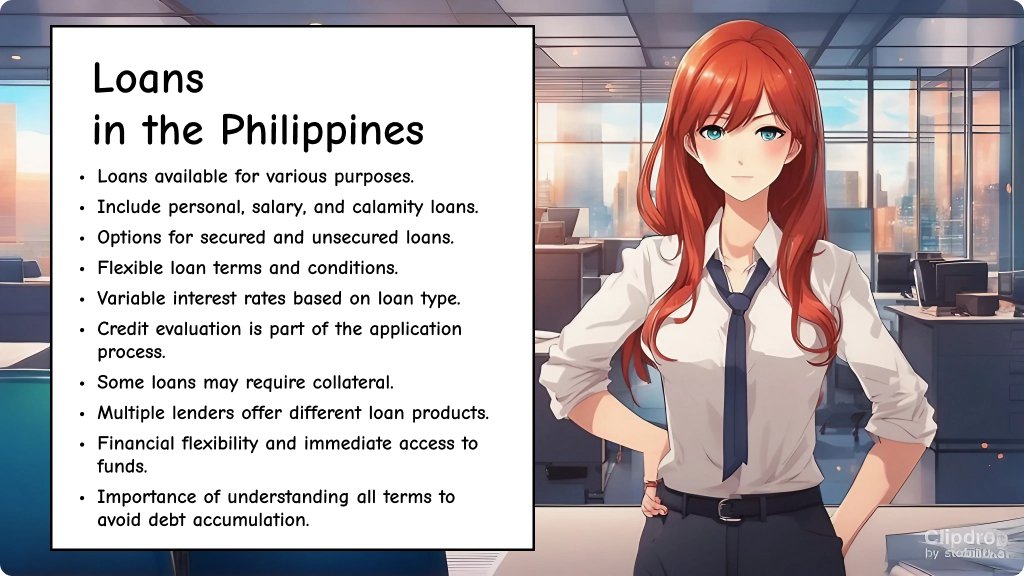
Quick overview
- Loans available for various purposes.
- Include personal, salary, and calamity loans.
- Options for secured and unsecured loans.
- Flexible loan terms and conditions.
- Variable interest rates based on loan type.
- Credit evaluation is part of the application process.
- Some loans may require collateral.
- Multiple lenders offer different loan products.
- Financial flexibility and immediate access to funds.
- Importance of understanding all terms to avoid debt accumulation.
What are loans in the Philippines?
The financial landscape in the Philippines also features specialized loan types, such as calamity loans. These are specifically designed to aid residents in areas declared to be in a state of calamity, and are typically facilitated by government entities like SSS and Pag-IBIG. For more substantial financial needs, secured loans like auto loans and home equity loans are prevalent. These loans necessitate collateral, often in the form of the financed property, ensuring the lender's interest in the asset until the entire loan amount is repaid. In terms of eligibility and features, each loan type varies, addressing the diverse financial requirements of the Filipino population. These loans come with their own set of terms, including interest rates, monthly payment, and sometimes, additional processing fees or insurance costs. The approval of such loans often depends on the borrower's credit history, with factors like higher interest rates for borrowers with riskier credit profiles, or lower interest rates for those with stronger credit histories.
What are the major types of loans?
-
Unsecured Loans. Unsecured loan in the Philippines are characterized by the absence of collateral requirements. This makes them a viable option for individuals who do not wish or are unable to pledge assets. Personal loans fall into this category, offering flexibility for various needs, including home improvements, travel, or consolidating debt. The approval of these loans heavily depends on the borrower's income and creditworthiness.
-
Secured Loans. Secured loans require the borrower to offer collateral, which reduces the lender's risk. A common type of secured loan is the auto loan, where the vehicle being purchased acts as the collateral. If the borrower defaults on payments, the lender has the right to repossess the car. Home loans are another form of secured loans, where the financed property itself is used as collateral, often resulting in lower interest rates due to the lender's enhanced security.
-
Fixed-Rate Loans. With fixed-rate loans, the interest rate remains unchanged for the entire duration of the loan. This type of loan includes housing loans, where the interest rate is set for the entirety of the repayment period. It enables borrowers to plan their finances more effectively, as they are assured that their monthly installments will remain constant throughout the loan term.
-
Variable-Rate Loans. In variable-rate loans, like business loans, the interest rate fluctuates based on market dynamics, often linked to certain financial indices. These loans might start with lower interest rates, but they carry the risk of interest rate variability. Entrepreneurs often opt for these loans when seeking funds for business growth, weighing the initial lower costs against the potential for future rate increases.
Features
-
Purpose Diversity. Loans are designed to meet a wide array of financial needs, from covering personal expenses and funding home acquisitions to supporting business growth and addressing urgent financial situations.
-
Variable Loan Terms. Loans come with diverse durations, including brief payday loans, intermediate personal loans, and extended mortgages, fitting various repayment schedules according to the borrower's requirements.
-
Interest Rate Variation. Interest rates in loans can be either fixed or variable. Fixed-rate loans provide a steady interest rate throughout the loan's duration, ensuring stability. Conversely, variable-rate loans adjust in response to prevailing market trends.
-
Credit Evaluation. The assessment of a borrower's credit standing is pivotal in determining loan approval and interest rates. Strong credit records can lead to better loan conditions and enhanced chances of approval.
-
Collateral Requirements. Secured loans demand assets as collateral, such as property or vehicles, whereas unsecured loans, devoid of such requirements, depend more significantly on the borrower's credit standing.
-
Repayment Structures. Various repayment methods are available for loans, ranging from regular monthly payments and one-time bulk payments to adaptable payment plans, catering to the borrower's financial capability.
-
Loan Amount Flexibility. The loan amount accessible to borrowers varies greatly, from minor amounts in payday loans to considerable sums for property or business investments, addressing a wide range of financial needs.
-
Application and Approval Processes. The procedures for applying and obtaining approval for loans differ among lenders and may include documentation submission, credit assessments, and sometimes personal interviews.
-
Risk and Responsibility. Borrowers bear the obligation of repaying the loan with interest. Non-repayment can lead to severe repercussions like confiscation of assets or detrimental effects on credit ratings.
-
Lender Diversity. A multitude of entities offer loans, encompassing traditional banks, digital lending platforms, credit unions, and government bodies, giving borrowers numerous options depending on their preferences and financial situations.
Pros and Cons
Pros
-
Financial Flexibility. Loans provide crucial financial leeway for both individuals and businesses, enabling significant purchases like homes or vehicles, kickstarting new businesses, or efficiently managing unexpected costs.
-
Immediate Access to Funds. Loans facilitate swift access to capital, crucial for addressing urgent financial needs, thereby eliminating the delay often associated with accumulating funds over time.
-
Asset Acquisition. Through secured loans, individuals have the opportunity to own assets, such as real estate or automobiles, by leveraging financing solutions that come with practical repayment schedules.
Cons
-
Interest Costs. The necessity of paying interest on loans adds an extra financial layer to the borrowed sum. Especially high-interest rates can escalate the overall expense burden of the loan.
-
Debt Accumulation. Indiscriminate borrowing and inadequate financial planning can lead to mounting debt, making it increasingly difficult to fulfill payment obligations.
-
Risk of Default. Inability to adhere to repayment schedules can lead to loan default, carrying adverse effects like deteriorating credit scores and the risk of losing assets used as collateral.
How to Get a Loan in the Philippines?
-
Determine Your Loan Purpose. Begin by precisely identifying the reason for the loan, whether it's for acquiring a property, establishing a business, or managing personal financial needs. Each type of loan serves distinct purposes, and clarity in your objective aids in selecting the appropriate loan category.
-
Check Your Credit Score. Access your credit report and evaluate your credit score. An impressive credit score can increase your chances of loan approval and potentially result in lower interest rates. Ensure to rectify any errors in your credit report prior to applying.
-
Research Loan Options. Investigate various financial institutions, such as banks, credit unions, online financiers, and governmental bodies. Scrutinize and compare their offered interest rates, terms, and qualifying criteria to find the most suitable loan option with reasonable payment conditions.
-
Understand Loan Terms. Carefully examine the loan's terms and conditions, including the interest rates, payment schedules, additional fees, and penalties for early repayment. Comprehensive understanding of these terms is essential to fully grasp the financial commitment involved.
-
Gather Necessary Documentation. Prepare required documents in advance, such as income proof, employment verification, credit history, and loan purpose. Organizing these documents ahead of time can speed up the application process.
-
Complete the Loan Application. Fill out the loan application form for your selected lender. While many applications can be completed online, some might necessitate a personal visit. It's crucial to provide accurate and honest information.
-
Wait for Loan Approval. After submission, the lender will assess your application, considering your credit status, income, and loan objective. The time taken for approval varies across lenders, and you might receive preliminary approval indicating the probability of a successful application.
-
Review Loan Offer. Once your application is approved, scrutinize the loan offer, paying close attention to the interest rates, repayment terms, and any applicable fees. It's important to understand every aspect of the loan agreement before consenting.
-
Submit Additional Documents if Required. Lenders may sometimes request further documents or clarifications during the approval stage. Promptly providing any additional requested documentation helps in avoiding any hold-ups in the process.
-
Accept the Loan and Fulfill Conditions. If the terms are agreeable, formally accept the loan offer. Comply with any stipulated conditions set forth by the lender, such as offering collateral or providing more information.
-
Receive Loan Disbursement. Upon fulfilling all requirements, the lender will release the loan funds. The disbursement may be directly transferred to your bank account or issued as a check, depending on the arrangement.
Requirements and Conditions
Conditions
-
Interest Rate Type. Applicants can select from fixed or variable interest rate options. Fixed interest rates remain unchanged, offering stability, whereas variable rates can vary, reflecting market trends.
-
Loan Type. Borrowers have the choice of unsecured or secured loan options. Unsecured loans, like payday loans, don't necessitate collateral, while secured loans, including auto loans and home equity loans, require an asset as collateral.
-
Repayment Schedule. The loan agreement details the repayment plan, specifying the frequency and size of payments, whether they are monthly installments or another agreed-upon schedule.
-
Prepayment Penalties. Some loan agreements may incorporate fees for early repayment, intended to safeguard the lender's interest earnings.
-
Late Payment Fees. Fees may be applied for delayed payments, motivating borrowers to adhere to the payment schedule.
-
Grace Period. A grace period may be provided, offering a temporary reprieve before payment commencement, aiding borrowers during short-term financial difficulties.
-
Minimum Loan Amount. Lenders often set a minimum borrowing limit to ensure the administrative costs of processing the loan are covered.
-
Maximum Loan Amount. A maximum borrowing limit is also typically set, balancing the risk for the lender and aligning with the borrower's financial capacity.
-
Loan Approval Conditions. Preliminary approval might require fulfilling certain conditions like providing supplementary documentation or meeting specific eligibility criteria.
-
Regulatory Compliance. Both lenders and borrowers must adhere to the legal and regulatory standards that govern lending practices.
Requirements
-
General Eligibility. Eligibility criteria for loan applicants in the Philippines usually include being within the age range of 21 to 65 years, Filipino residency, and a functioning landline number for communication.
-
Income Requirements. Employed individuals must present a valid government ID (e.g., passport), proof of income like the latest ITR, Employment Certificate, or recent pay slip. Self-employed individuals are required to show an Audited Financial Statement, Business Permit, DTI Certificate or SEC Registration, references, recent bank statements, and the latest GIS for corporations.
-
Additional Documents for Foreigners. Foreign nationals seeking loans need to provide extra documents such as an Alien Certificate of Registration, a valid passport, and proof of residency.
-
Special Documents for Seamen. For OFW loans, necessary documents include a completed Lenderly Application, passport copy, Working Visa, Overseas Employment Certificate, Employment Contract, recent electric bills, valid government ID, airline ticket, Seaman's Book, and Seafarer's Registration.
Ways to Receive the Money
-
Direct Deposit to Bank Account. The prevalent mode for receiving loan funds is through direct deposit into the borrower's banking account. Following loan approval, the amount is electronically credited to the designated account.
-
Cash Disbursement. For smaller loan amounts, lenders might distribute the funds in physical currency. This requires the borrower to visit a bank branch or an assigned location to receive the cash.
-
Digital Wallet Transfer. As digital banking gains traction, some lenders facilitate the transfer of funds to digital wallets. Recipients can then utilize these funds for online transactions or transfer them to their traditional bank accounts.
-
Wire Transfer. For cross-border transactions or swift fund transfers, a wire transfer is often employed. This method involves the electronic transfer of funds, necessitating the borrower to furnish specific details for the transaction.
-
ACH Transfer. The Automated Clearing House network allows for electronic transfers between banks. This method is utilized by lenders to deposit the loan amount directly into the borrower's account.
Sources
- Loans by finanso.com
FAQs
The process of renewing an online loan can be relatively straightforward and quick, particularly if the borrower has effectively paid off and settled the previous loan in a timely manner. Some lending institutions might request refreshed proof of income, while others might only necessitate the borrower's signature on a few documents. If a loan application gets declined, the borrower is only eligible to submit another application after a period of 6 months.
In order to use an online loan calculator, the borrower is required to input their preferred loan sum and repayment duration. Subsequently, the calculator will display loan options that align with the borrower's input, arranged according to the interest rate. In addition, it will calculate the monthly repayment amount. To proceed with the application, the borrower can select the "Apply" button located next to each lender's offering.
Certainly, online loans are not only prevalent but also legal within the Philippines. That said, fintech firms and online lending platforms operating in the archipelago fall under the purview of the Securities and Exchange Commission (SEC) and the Bangko Sentral ng Pilipinas (BSP).
For these online loan platforms to function within the legal framework, they must adhere to several stipulations. This includes mandatory registration with the SEC, clear disclosure of all fees and associated charges to those wishing to borrow money, and observance of anti-money laundering and counter-terrorism funding protocols.
Moreover, it's imperative for these companies to be forthright about their loan terms, ensuring the utmost clarity regarding costs, fees, and other charges. Protecting the confidentiality and safety of borrowers' personal details is also paramount.
Prospective borrowers should diligently peruse the terms of any online loan agreement prior to commitment. Engaging exclusively with licensed and officially registered online lenders is pivotal for a secure transaction.